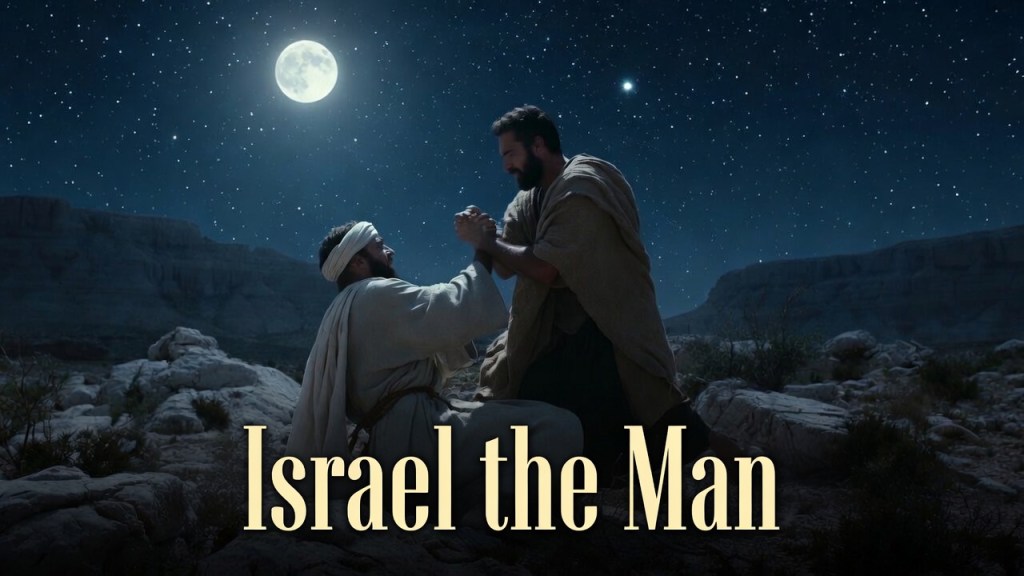
Israel the Man
People often forget, when talking about the subject of Israel, that “Israel” was originally the name of a man. Today the name is used in many different ways, and we see it is used in different ways throughout the Bible. This makes it very easy for people to misuse the name or misapply Bible verses that refer to Israel. The purpose of this article is to help readers understand that the word “Israel” is not used in only one way in the Scriptures. It appears in many different contexts, and it is important that we carefully determine how any specific verse about Israel should be applied. In this article we are going to talk about Israel the man. This man who originally was named Jacob, but a man whose name was changed by God to Israel.
“The Man Behind the Name”
Gen 32:27 And he said unto him, What is thy name? And he said, Jacob.
Gen 32:28 And he said, Thy name shall be called no more Jacob, but Israel: for as a prince hast thou power with God and with men, and hast prevailed.
If we apply the “first mention” principle, “Israel” refers first and foremost to this individual. While the name is not used exclusively for the individual man, every later usage is still connected to him. When we speak of the children of Israel, we are referring to the people who were a part of the nation God started with him. When we speak of the land of Israel, we are referring to the inheritance that belonged to this man. Let’s talk about this individual whom God named Israel. Most readers of this article are probably familiar with Jacob’s story, but let me highlight a few key points. He was the grandson of Abraham, whom God chose to be the father of many nations. One of those nations would come through the man later named Israel. Gen 17:1–5
Gen 17:1 And when Abram was ninety years old and nine, the LORD appeared to Abram, and said unto him, I am the Almighty God; walk before me, and be thou perfect.
Gen 17:2 And I will make my covenant between me and thee, and will multiply thee exceedingly
Gen 17:3 And Abram fell on his face: and God talked with him, saying,
Gen 17:4 As for me, behold, my covenant is with thee, and thou shalt be a father of many nations.
Gen 17:5 Neither shall thy name any more be called Abram, but thy name shall be Abraham; for a father of many nations have I made thee.
The Apostle Paul, under the inspiration of the Holy Ghost, noted that God spoke of this promise in the past tense:
Rom 4:17 (As it is written, I have made thee a father of many nations,) before him whom he believed, even God, who quickeneth the dead, and calleth those things which be not as though they were.
It is just like God to choose an old man with a barren wife to raise up a nation that cannot be numbered. God’s promises are so certain that He speaks of them as if they have already happened. Now let’s look at the foundational blessing, or what many call the Abrahamic Covenant: Gen 12:1–3
Gen 12:1 Now the LORD had said unto Abram, Get thee out of thy country, and from thy kindred, and from thy father’s house, unto a land that I will shew thee:
Gen 12:2 And I will make of thee a great nation, and I will bless thee, and make thy name great; and thou shalt be a blessing:
Gen 12:3 And I will bless them that bless thee, and curse him that curseth thee: and in thee shall all families of the earth be blessed.
“The Pattern of Inheritance: Abraham → Isaac → Jacob → Jesus”
Although Abraham had other sons, the covenant promises and inheritance passed to Isaac, not Ishmael or the sons of Keturah. Why? Because Abraham deliberately passed the inheritance to Isaac, and God confirmed that choice.
Gen 25:5 And Abraham gave all that he had unto Isaac.
Gen 25:6 But unto the sons of the concubines, which Abraham had, Abraham gave gifts, and sent them away from Isaac his son, while he yet lived, eastward, unto the east country.
God also appeared to Isaac and reaffirmed the blessing for Abraham’s sake (Gen 26:24).
Gen 26:24 And the LORD appeared unto him the same night, and said, I am the God of Abraham thy father: fear not, for I am with thee, and will bless thee, and multiply thy seed for my servant Abraham’s sake.
Isaac had two sons, but the blessing passed to Jacob rather than Esau, even though Jacob obtained it through deception.
Gen 27:29 Let people serve thee, and nations bow down to thee: be lord over thy brethren, and let thy mother’s sons bow down to thee: cursed be every one that curseth thee, and blessed be he that blesseth thee.
Notice the pattern: the full inheritance did not go to all of Abraham’s descendants, nor to all of Isaac’s. Yet when we reach Jacob/Israel, many people suddenly assume every biological descendant forever receives the full blessing.
“Why the Promises Were Never Automatic”
Important Questions: What exactly was the promise and blessing that God gave to Abraham, passed to Isaac (not Ishmael), and then to Jacob (not Esau)?
1. A coming Seed who would bless all the nations of the world (clearly Jesus).
2. A land inheritance for Abraham and his seed.
3. A promise to bless those who bless this people and curse those who curse it.
Everyone agrees this covenant did not automatically include all of Abraham’s or Isaac’s descendants. So here is the key question: If the inheritance did not go to all of Abraham’s descendants and not to all of Isaac’s descendants, why do so many assume it automatically went to every descendant of Jacob/Israel?
I believe the promises did go to Jacob’s twelve sons, but there is a clear biblical reason. Abraham passed the inheritance only to Isaac. Isaac passed it only to Jacob. Jacob, however, passed it to all twelve sons because they accepted his authority, continued to identify as his people, and were instructed to remain together as one nation under the law of their fathers. If any tribe broke away and forsook the covenant, they could be cut off.
Gen 17:14 And the uncircumcised man child whose flesh of his foreskin is not circumcised, that soul shall be cut off from his people; he hath broken my covenant.
“Jacob’s Blessing and the Role of Judah”
Being part of the nation of Israel was never only about genetics. Every nation has requirements for inclusion and ways to lose citizenship. The same was true for Israel. The Authority that Jacob (Israel) held was a real patriarchal authority that continued even after his death. We see also in Genesis 49 he specifically gave leadership of the tribes to Judah: Gen 49:8–10
Gen 49:8 Judah, thou art he whom thy brethren shall praise: thy hand shall be in the neck of thine enemies; thy father’s children shall bow down before thee.
Gen 49:9 Judah is a lion’s whelp: from the prey, my son, thou art gone up: he stooped down, he couched as a lion, and as an old lion; who shall rouse him up?
Gen 49:10 The sceptre shall not depart from Judah, nor a lawgiver from between his feet, until Shiloh come; and unto him shall the gathering of the people be.
Jacob made Judah the lead tribe (after Reuben, Simeon, and Levi disqualified themselves). God later confirmed this (Judges 1:1–2). The tribes were to remain together and follow Judah’s line until Shiloh (a title for the Messiah) came. Then they were to gather to Him. Jesus Christ is that promised Seed and Shiloh. When He arrived, those who rejected Him were cut off from the covenant (Acts 3:22–23), exactly as Moses had warned.
Act 3:22 For Moses truly said unto the fathers, A prophet shall the Lord your God raise up unto you of your brethren, like unto me; him shall ye hear in all things whatsoever he shall say unto you.
Act 3:23 And it shall come to pass, that every soul, which will not hear that prophet, shall be destroyed from among the people.
This is quoting Deuteronomy 18:15
Deu 18:15 The LORD thy God will raise up unto thee a Prophet from the midst of thee, of thy brethren, like unto me; unto him ye shall hearken;
The Law and the promises were forever promises, but those laws and promises included changes that would take place when the Seed came.
The children of Israel struggled with the changes that came with the new and better covenant because they had done things a certain way for so long, but the apostles showed them that forsaking the carnal ordinances of the Law and of the Temple were actually according to the Law.
Act_7:37 This is that Moses, which said unto the children of Israel, A prophet shall the Lord your God raise up unto you of your brethren, like unto me; him shall ye hear.
While the Word of God is eternal the instructions in the Law had things that were temporary. Those things served a purpose and they served their purpose. When the Messiah came everything changed and those who did not follow after Christ were cut off from the people of God, because God doesn’t break His promises to Israel. God kept His promise to Israel, and that included the negative promises.
“The Coming of Shiloh and the New Covenant”
Now let’s follow the promise that God gave to Abraham? Abraham passed it down to Isaac and not Ishmael. Isaac passed it to Jacob not Esau and Jacob passed it to his 12 sons who were supposed to follow their brother Judah until Shiloh came and Shiloh (Jesus) received the blessing and all who are in Christ are now a part of that eternal covenant. It was never just about biological descendants.
When the Bible calls Jesus the Lion of the tribe of Judah it isn’t just giving him a cool title. This is showing that Jesus is the one that Jacob/Israel passed the inheritance on to.
Gen_49:9 Judah is a lion’s whelp: from the prey, my son, thou art gone up: he stooped down, he couched as a lion, and as an old lion; who shall rouse him up?
Rev 5:5 And one of the elders saith unto me, Weep not: behold, the Lion of the tribe of Juda, the Root of David, hath prevailed to open the book, and to loose the seven seals thereof.
We see that the law was added “because of transgressions, till the seed should come to whom the promise was made” (Gal 3:19). Once the Seed arrived, the temporary aspects of the old system were fulfilled. Those who refused to follow the Messiah were removed from the people of God, while those who believed entered the eternal covenant and gentiles were included as well.
Rom 9:22 What if God, willing to shew his wrath, and to make his power known, endured with much longsuffering the vessels of wrath fitted to destruction:
Rom 9:23 And that he might make known the riches of his glory on the vessels of mercy, which he had afore prepared unto glory,
Rom 9:24 Even us, whom he hath called, not of the Jews only, but also of the Gentiles?
It has never been possible to claim the promises and blessings of Israel apart from Jesus Christ. The promises were never intended for every biological descendant of Abraham, Isaac, or Jacob. They were always for those who remained in the covenant. When the Messiah came, the covenant continued in Him. All who are in Christ by faith are the true heirs. Gal 3:27–29
Gal 3:27 For as many of you as have been baptized into Christ have put on Christ.
Gal 3:28 There is neither Jew nor Greek, there is neither bond nor free, there is neither male nor female: for ye are all one in Christ Jesus.
Gal 3:29 And if ye be Christ’s, then are ye Abraham’s seed, and heirs according to the promise.
My connection to Israel the man is not genetic; it is spiritual based on the authority of God’s Word. The promises of God are not based on flesh and blood. This is why Jesus told Nicodemus “Ye must be born again”. This is why we are born again not of corruptible seed (the flesh) but by incorruptible seed (the Word of God). When I believed I was baptized into Christ by faith and became a child of Abraham. God is not going to break His promise to Israel. God has kept it perfectly in Jesus Christ. Those who are biological descendants of unbelieving Israelites can still receive the promises made to their biological fathers, but only if they abide not still in unbelief. If they remain in a state of unbelief then they will remain under the curse because Galatians 3:10-11
Gal 3:10 For as many as are of the works of the law are under the curse: for it is written, Cursed is every one that continueth not in all things which are written in the book of the law to do them.
Gal 3:11 But that no man is justified by the law in the sight of God, it is evident: for, The just shall live by faith.
“Not All Israel Is Israel (Romans 9)”
It makes no sense to credit the blessings and promises that God made to Abraham, Isaac, and Israel to a people whose only connection is a physical one. Just because they are using the name Israel does not mean they are connected to the Israel of promise.
Rom 9:6 Not as though the word of God hath taken none effect. For they are not all Israel, which are of Israel:
Rom 9:7 Neither, because they are the seed of Abraham, are they all children: but, In Isaac shall thy seed be called.
Rom 9:8 That is, They which are the children of the flesh, these are not the children of God: but the children of the promise are counted for the seed.
God has not failed Israel the Man. He has fulfilled every promise in Jesus Christ, the true Seed. And today the invitation remains: whoever believes in Him becomes part of the Israel of God.”


Leave a Reply